
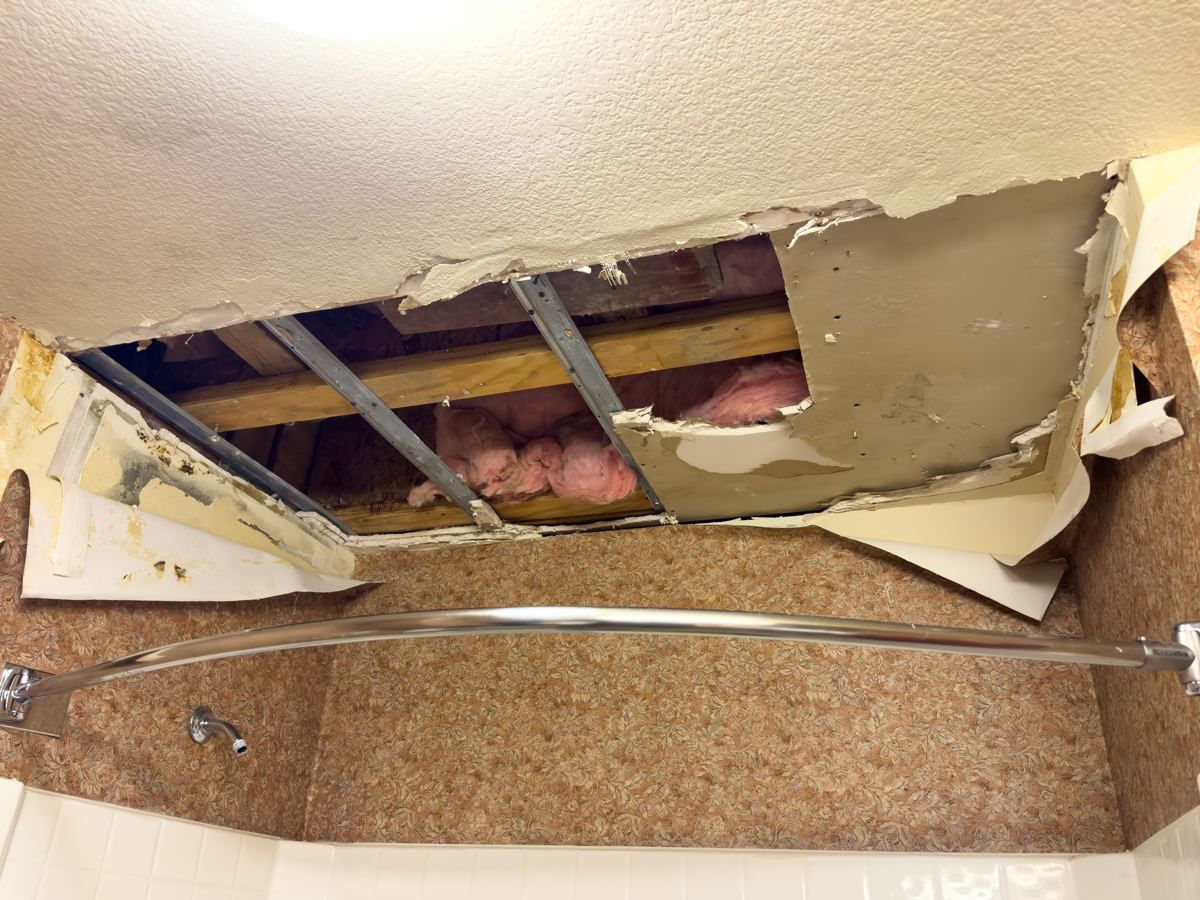
Summer in Gainesville is hard on houses. The air sits heavy, afternoon storms roll through, and air conditioners run all day. Drywall is made of gypsum between two layers of paper, and paper likes moisture more than it should. This guide covers what humidity does to your walls and ceilings, what to look for, what you can do yourself, and when it is time to call someone.
What humidity does to drywall
Drywall stays flat and strong when it stays dry. When moisture gets into the board, a few things happen. The paper face can swell and bubble. Joint tape can loosen and curl. Compound can soften at seams. And in the worst case, the paper becomes food for mold.
The EPA says the way to keep mold from growing indoors is to control moisture, and it suggests keeping indoor humidity between 30 and 50 percent. That is easier said than done in North Central Florida in July. Your air conditioner is doing the heavy lifting. If it is oversized, it cools the house fast and shuts off before it pulls much moisture out of the air. If it is undersized or dirty, the house stays warm and damp.
Most homes never reach the point of real damage. But small signs of trouble show up early if you know where to look.
Signs your drywall is telling you something
- Bubbles or blisters under the paint, usually on an outside wall or in a bathroom.
- Hairline cracks along taped seams, especially at ceiling lines and above doors.
- Tape that has lifted or curled at a corner.
- Yellow or brown stains on a ceiling, often with a darker ring at the edge.
- Soft spots where a finger presses in without much effort.
- A musty smell that comes and goes, stronger on humid days.
One sign alone does not mean disaster. A hairline crack over a door is almost always movement. A brown ring on the ceiling almost always means water. When two or three signs show up on the same wall, look for the cause.
Where moisture comes from
Humidity is only one source. Moisture reaches drywall from several directions, and the fix depends on which one it is.
Air conditioner drain lines
Your AC pulls water out of the air all summer. That water runs through a drain line, usually PVC, out of the house. When the line clogs with algae, the pan overflows and water drips onto the ceiling or into a wall below. Ceiling stains below an attic air handler are very often this. A clogged drain line is a cheap fix. A soaked ceiling is not.
Roof leaks after storms
Hurricane season runs from June 1 to November 30, according to NOAA, and afternoon thunderstorms through the summer test every roof. A loose shingle or a bad flashing lets water into the attic, where it soaks insulation and finds the ceiling below. By the time a stain shows up, the board above it can already be wet.
Bathroom humidity
Showers put gallons of water vapor into a small room. A fan that vents to the outside takes it away. A fan that vents into the attic, or no fan at all, leaves it to settle on walls and ceilings. Paint peels first. Then the board behind it starts to go.
Plumbing leaks
Supply lines and drains inside walls leak slowly. You might see a stain at the baseboard, a swollen baseboard, or a patch of wall that feels cool. Slab leaks can wick moisture up the bottom of a wall.
Condensation on cold surfaces
Cold air ducts in a hot attic sweat, and that water drips onto the ceiling below. Poorly sealed or poorly insulated ducts are a common cause of ceiling stains that follow the line of a duct.
How fast you need to act
Speed matters. The EPA says that wet materials dried within 24 to 48 hours generally do not grow mold. After that, the risk goes up. So if you have a known leak, a flooded room, or a storm that blew water into a wall, fans and a dehumidifier running right away can save the board.
If the board is soaked, soft, or has been wet for days, drying it in place usually will not work. Wet board is heavy, weak and a good home for mold. It needs to come out. If the board is only damp and the water was clean, drying can work, but you should check it with a moisture meter before anyone closes it back up.
What to do yourself
- Stop the water. Fix the leak, clear the drain line, or tarp the roof. Nothing else lasts without this step.
- Move air. Run fans and a dehumidifier, and keep the AC on.
- Take photos for insurance with a tape measure in the frame.
- Pull baseboard if it is swollen, so the wall can breathe at the bottom.
- Do not paint over a stain. It will bleed through, and it hides a problem you still have.
- Check your bathroom fan. Hold a tissue under it. If it does not stick, the fan is weak or blocked.
These are easy and cheap. If after a few days the wall still feels damp or smells musty, call a pro.
What a pro does differently
The first thing a pro brings is a moisture meter. It tells you how wet the board really is, and how far the wet area goes beyond the visible stain. The second is a plan to open only what is wet and leave the rest alone.
On a typical water damage job, we cut out the wet section along the stud lines. We let the cavity dry. We replace any wet insulation. Then we hang new board, tape it, coat it and match the texture. Stain-blocking primer goes on before paint. A wet 4 by 8 foot section cut out and replaced ran $820 on one past job, and the published range for a water damage section runs about $350 to $1,200 depending on size and finish.
You can read about the full process on our water damage drywall repair page. If the damage is on a ceiling, see drywall ceiling repair.
Choosing board for damp rooms
In bathrooms, laundry rooms and utility closets, ask for moisture-resistant board. It has a treated face that holds up to humidity better than standard board. It costs more per sheet, which can push a big job toward the top of its range, but it is cheap insurance in a room that runs damp.
It is not waterproof. Inside a shower or around a tub, tile needs cement board or a waterproof membrane under it. We cover the difference on the moisture and mold-resistant drywall page.
Finishing in humid weather
If you are having drywall hung or finished in summer, expect it to take longer. Joint compound dries by evaporation, and humid air slows evaporation. A coat that is dry in a day in a dry climate may need two. Rushing a coat before it is dry leads to cracks, shrinkage and ridges.
Keep the AC running during the job. A steady house temperature helps compound dry on schedule. Open windows on a humid day do the opposite. A three-day finish on a bedroom is typical here, and a rainy week can stretch it. See drywall taping and mudding for what each coat does.
A short seasonal checklist for Gainesville homes
Before summer storms
- Flush the AC drain line and check the pan.
- Look at the roof for loose shingles and flashing.
- Clear gutters so water does not back up at the edge.
- Test your bathroom fans.
During the wet season
- Check ceilings after big storms, especially below the attic air handler.
- Keep indoor humidity in the range the EPA suggests, and use a dehumidifier in closed rooms.
- Look behind furniture that sits tight against outside walls.
After hurricane season ends
- Walk the house and photograph any new stains or cracks.
- Schedule repairs for the cooler, drier months, when compound dries faster.
- Fix small things now so they do not become big things next June.
Cracks versus leaks: how to tell
Cracks and stains look different. A crack is a line, usually straight, usually along a seam or off the corner of a door or window. It comes from movement. Florida houses move with the seasons because wood framing swells in wet months and dries in dry ones. These are repaired by cutting out old tape and setting new tape in setting compound, then coating wide. You can see what that looks like on our drywall repair page.
A stain is an area of color, usually brown or yellow, often with a ring. It means water. The leak has to be found. And if the stain is on a ceiling, it may sit directly under the leak or be several feet off, because water travels along framing before it drips.
When textured ceilings and walls get involved
If your ceiling is popcorn and you have a stain, you may be facing two jobs. If the house was built before the mid-1980s, the EPA advises testing the texture for asbestos before it is disturbed. We send a sample to a lab. If it is clear, a stained section can be cut out and the ceiling patched. If you want the whole ceiling smooth, see popcorn ceiling removal.
Textured walls need matching after any repair. Orange peel and knockdown are the common ones here. Our texture matching page explains how we test the match before touching your wall.
What this costs
We keep a local rate card, and the numbers below are planning ranges, not quotes. Your price is confirmed in person.
- Most single repairs: $250 to $800, with a minimum charge per visit.
- Water damaged section: about $350 to $1,200.
- Tear-out and replacement: about $2.20 to $4.25 per square foot.
- Skim coat: about $0.95 to $1.30 per square foot.
- Primer plus two coats of paint: about $1.05 to $2.80 per square foot.
The rate card draws on published national cost guides from Angi, HomeAdvisor, HomeGuide, Fixr and Thumbtack, adjusted for Florida labor using Bureau of Labor Statistics wage data. You can run your own numbers on the cost calculator.
The short version
Keep the house dry and the cracks small. Fix leaks before you fix walls. If something is wet, move fast. If something is old, test it. And if you are not sure what you are looking at, send us photos with the estimate form. We will tell you what we see before anyone picks up a tool.